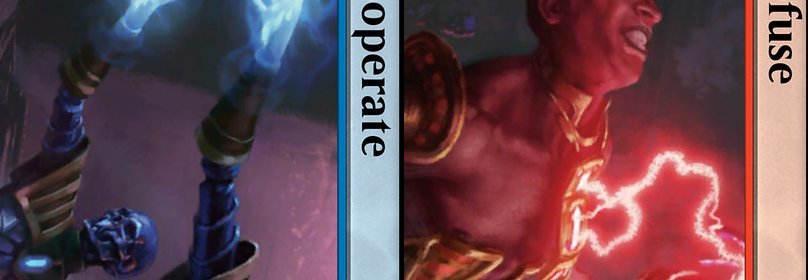
Refuse // Cooperate Price
4 printings · 4 sets · first printed 2017
Refuse // Cooperate has been printed 4 times across 4 sets, first in 2017 and most recently in 2020. Right now the cheapest printing is Commander 2019 #199 at $0.16, while the most expensive is Hour of Devastation Promos #156s at $0.64 — about 4× more. The median across 3 priced printings is $0.23. Reprint risk: HIGH RISK — Reprinted 4x, including dedicated reprint sets like Amonkhet Remastered, Commander 2019.
Clicking links to purchase cards directly supports ManaBleed via affiliate commissions at no extra cost to you.
Every Refuse // Cooperate Printing, Compared
Cheapest first · unpriced last| Printing | Year | Price | Dealer Buys |
|---|---|---|---|
| Commander 2019 #199 (R) Cheapest | 2019 | $0.16 | — |
| Hour of Devastation #156 (R) | 2017 | $0.23 | — |
| Hour of Devastation Promos #156s (R) Foil | 2017 | $0.64 | $0.52 foil |
| Amonkhet Remastered #255 (R) | 2020 | — | — |
Prices are the latest nightly market price; a printing with no tracked price shows a dash. Dealer buylist is Card Kingdom's current offer via MTGJSON, shown where one exists.




Legality is a property of the card, not the printing, so it is identical for all 4 versions.
Official Judge Precedents
19 PrecedentsSplit cards with aftermath have a new frame treatment—the half you can cast from your hand is oriented the same as other cards you'd cast from your hand, while the half you can cast from your graveyard is a traditional split card half. This frame treatment is for your convenience and has no rules significance.
All split cards have two card faces on a single card, and you put a split card onto the stack with only the half you're casting. The characteristics of the half of the card you didn't cast are ignored while the spell is on the stack. For example, if an effect prevents you from casting green spells, you can cast Destined of Destined // Lead, but not Lead.
Each split card has two names. If an effect instructs you to choose a card name, you may choose one, but not both.
Each split card is a single card. For example, if you discard one, you've discarded one card, not two. If an effect counts the number of instant and sorcery cards in your graveyard, Destined // Lead counts once, not twice.
If another effect allows you to cast a split card with aftermath from any zone other than a graveyard, you can't cast the half with aftermath.
While not on the stack, the characteristics of a split card are the combination of its two halves. For example, Destined // Lead is a green and black card, it is both an instant card and a sorcery card, and its mana value is 6. This means that if an effect allows you to cast a card with mana value 2 from your hand, you can't cast Destined. This is a change from the previous rules for split cards.
If you cast the first half of a split card with aftermath during your turn, you'll have priority immediately after it resolves. You can cast the half with aftermath from your graveyard before any player can take any other action if it's legal for you to do so.
A spell with aftermath cast from a graveyard will always be exiled afterward, whether it resolves, it's countered, or it leaves the stack in some other way.
If another effect allows you to cast a split card with aftermath from a graveyard, you may cast either half. If you cast the half that has aftermath, you'll exile the card if it would leave the stack.
If the spell that's copied has an X whose value was determined as it was cast (like Torment of Hailfire does), the copy will have the same value of X.
The controller of a copy can't choose to pay any alternative or additional costs for the copy. However, effects based on any alternative or additional costs that were paid for the original spell are copied as though those same costs were paid for the copy.
The copy is created on the stack, so it's not "cast." Abilities that trigger when a player casts a spell won't trigger.
If the spell has damage divided as it was cast (like Chandra's Pyrohelix), the division can't be changed (although the targets receiving that damage still can).
If the spell that's copied is modal (that is, it says "Choose one —" or the like), the copy will have the same mode. A different mode can't be chosen.
If you copy a spell, you control the copy. It will resolve before the original spell does.
If a spell has  in its mana cost, include the value chosen for that X when determining the mana value of that spell.
Cooperate can copy any instant or sorcery spell, not just one with targets.
Once you've started to cast a spell with aftermath from your graveyard, the card is immediately moved to the stack. Opponents can't try to stop the ability by exiling the card with an effect such as that of Crook of Condemnation.
The copy will have the same targets as the spell it's copying unless you choose new ones. You may change any number of the targets, including all of them or none of them. If, for one of the targets, you can't choose a new legal target, then it remains unchanged (even if the current target is illegal).